Highlights
Physiological and Multi-Omics Analyses Reveal Plasticity of Carbon Concentrating Mechanisms (CCMs) in Hygrophilla difformis
Carbon dioxide diffuses slowly in water, leaving aquatic plants chronically short of carbon sources and driving the evolution of diverse carbon-concentrating mechanisms. While the well-studied species are fully submerged plants, the carbon-concentrating mechanisms in amphibious plants remain poorly understood. Hygrophila difformis, a typical heterophyllous plant, adapts to terrestrial and aquatic habitats via phenotypic plasticity, yet its underlying physiological regulatory mechanisms remained unclear.
Recently, a research group led by Prof. HOU Hongwei from the Institute of Hydrobiology (IHB) of the Chinese Academy Sciences found that H. difformis develop highly physiological plasticity in CCMs to adapt to terrestrial and submerged environments. This study was published in Horticulture Research.
The researchers first performed anatomical and physiological analysis in H. difformis and found that terrestrial leaves of H. difformis exhibit typical anatomical and photosynthetic traits of C3 plants, with δ13C values and Rubisco activity consistent with the typical C3 photosynthetic pathway. In contrast, submerged leaves show markedly elevated δ13C values and a metabolic shift toward C4-like photosynthesis, alongside a stronger capacity for bicarbonate utilization.
Subsequently, enzymatic activity and multi-omics data verified that submerged H. difformis activates an NAD-ME type, single-cell C4-like photosynthetic pathway. Key C4 enzymes are significantly upregulated under submergence, whereas core enzymes, genes and metabolites of the Calvin cycle are suppressed, indicating metabolic reprogramming characterized by inhibited C3 photosynthesis and activated C4 carbon-concentrating mechanisms underwater.
Further analyses showed that submerged leaves develop dimorphic chloroplasts in mesophyll cells, an adaptive trait for low CO2 and weak light underwater. Additionally, the team performed a genome-wide identification of the carbonic anhydrase (CA) gene family in H. difformis, identifying a total of 21 CA genes.
This study confirms that H. difformis relies on combined morphological, structural and physiological plasticity for environmental adaptation. It elucidates the transition and regulation of carbon assimilation between C3 and C4-like pathways in aquatic plants and establishes H. difformis as a model plant for investigating heterophylly in aquatic species.
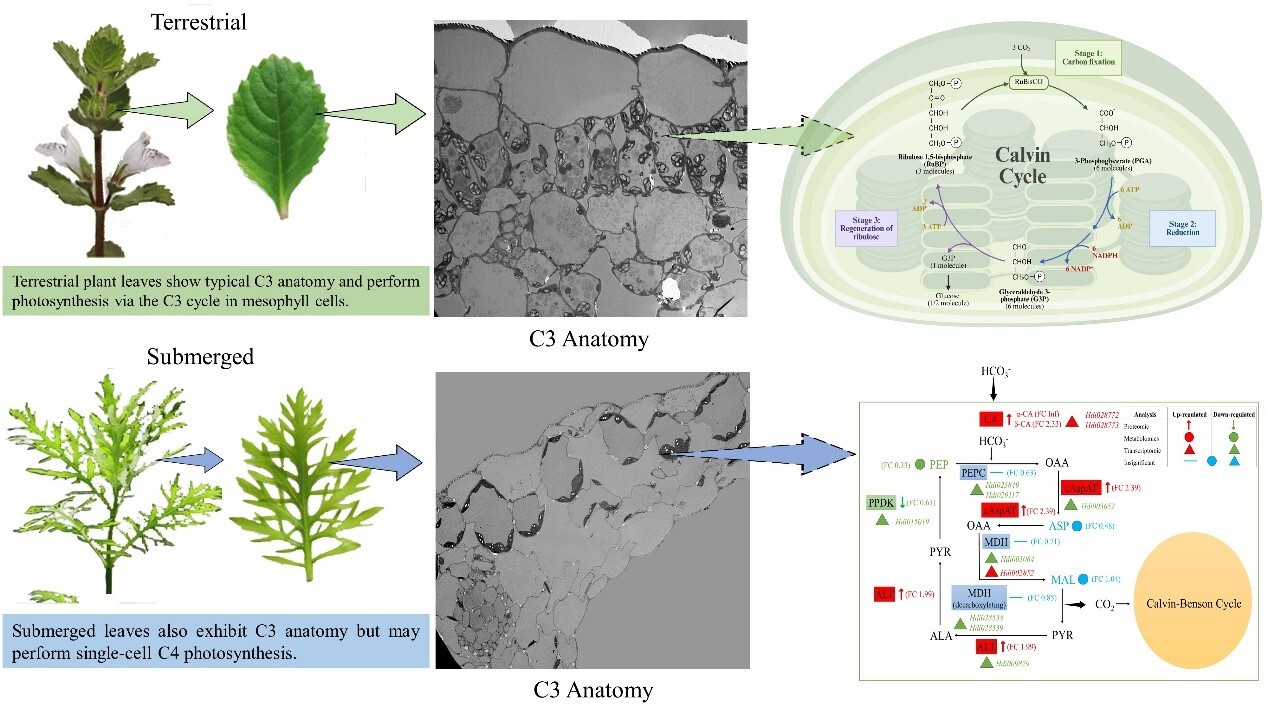
Phenotypic, anatomical, and physiological adaptation of Hygrophila difformis in terrestrial and submerged conditions. (Image by IHB)
(Editor: MA Yun)