Newsroom
Study Reveals How Climate Warming Intensifies Insect Outbreaks to Suppress Aquatic Plant Recovery
Climate warming is reshaping ecosystems at an unprecedented rate, yet its influence on population outbreaks and subsequent ecological consequences remains poorly understood. Submerged aquatic plants play a vital role in maintaining clear-water states in freshwater lakes, but their recovery can be disrupted by multiple stressors.
In a study published in Ecology, a research team led by Prof. XU Jun from the Institute of Hydrobiology (IHB) of the Chinese Academy of Sciences, in collaboration with Peking University, University of Essex, and Huazhong Agricultural University, has uncovered a novel mechanism by which climate warming impedes the recovery of submerged plants through intensified herbivory during insect outbreaks.
The researchers conducted a large-scale mesocosm experiment using 48 outdoor ponds (each 2500 L) to simulate shallow lake ecosystems under ambient and warmed conditions (+3.5°C with simulated heatwaves). During the experiment, an unexpected outbreak of the aquatic moth Parapoynx diminutalis provided a unique opportunity to examine how warming interacts with insect outbreaks to affect aquatic plants.
The results showed that warming advanced plant phenology, leading to an earlier growth peak in spring. However, the outbreak of moth larvae was significantly more severe under warmed conditions. The increased larval density, particularly on the dominant plant species Hydrilla verticillata, enhanced grazing pressure and drastically reduced plant biomass and regenerative capacity.
The loss of aquatic plants released nutrients into the water column, promoting phytoplankton blooms and shifting the ecosystem from a clear-water, macrophyte-dominated state to a turbid, algae-dominated state. This transition was more pronounced under warming, where higher concentrations of total nitrogen, total phosphorus, and phytoplankton chlorophyll a were recorded.
The study demonstrates, for the first time experimentally, that climate warming can amplify insect outbreak events, weaken plant recovery, and push freshwater ecosystems toward degraded turbid states. The findings highlight the risk of coupled extreme climate and population outbreak events in the future, and suggest that preventive measures, such as introducing small insectivorous fish, should be considered in aquatic plant restoration experiments. This research underscores the need to account for climate-mediated biotic interactions in predicting and managing freshwater ecosystem stability.
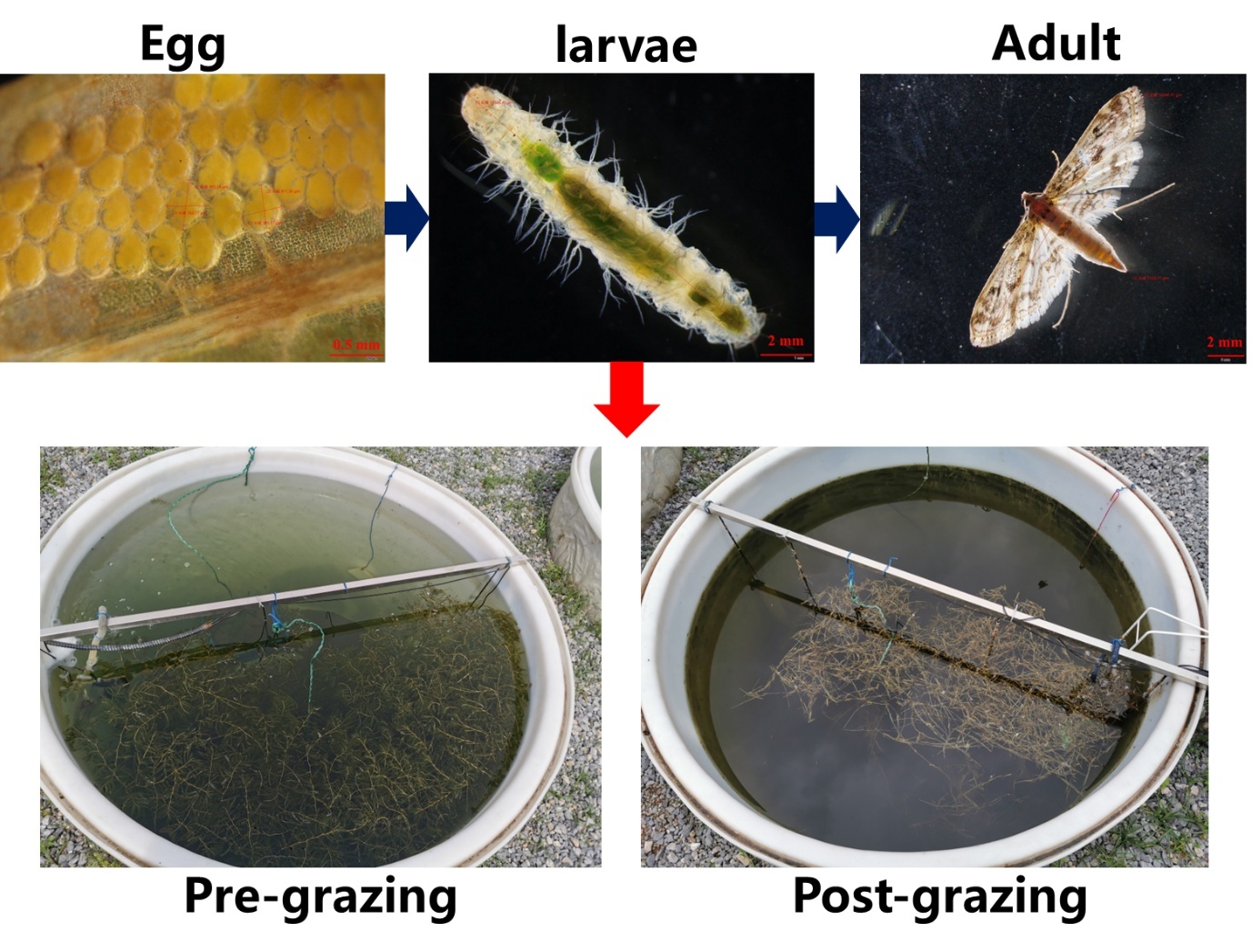
Different life stages of Parapoynx diminutalis and its larval grazing impact on submerged plants (Image by IHB)
(Editor: MA Yun)